The Founding Conviction - Why ECES was created and why EURECS emerged from that conviction
When Fabio Bargiacchi concluded his work with the Joint EC–UNDP Task Force on Electoral Assistance in 2010 to establish the European Centre for Electoral Support, he did so with a clear institutional diagnosis. Europe had become one of the world’s leading supporters of democracy, electoral assistance and human rights. The European Union had progressively developed a sophisticated legal, financial and policy architecture that included landmark policy documents, dedicated financing instruments and an increasingly comprehensive external democracy agenda.
Among these milestones, the European Commission Communication COM(2000)191 on Election Assistance and Observation represented a turning point by institutionalising the complementarity between election observation and electoral assistance and by promoting long-term engagement throughout the electoral cycle.
Yet one important element remained missing. Europe lacked a specialised, independent, neutral and non-profit implementation platform capable of translating European policies, values and Member State priorities into practical support adapted to the realities of partner countries.
What was needed was not another donor or policy institution, but a permanent implementation mechanism able to combine European principles with local ownership, technical excellence with political sensitivity, innovation with accountability and operational flexibility with institutional consistency.
ECES was established in Brussels in 2010 by experienced electoral and democracy-support practitioners to respond to precisely that need. The organisation also benefited from the vision and fundamental support of the late Abbé Apollinaire Malu Malu, former President of the Electoral Commission of the Democratic Republic of the Congo and former Chairperson of the Electoral Commissions Forum of SADC Countries.
Coming from different institutional experiences, the founders shared the same conviction: sustainable democracy support required implementation mechanisms built on partnership rather than prescription, dialogue rather than conditionality, and long-term institutional accompaniment rather than short electoral interventions.
From its very first programmes, ECES implemented activities according to principles that would later become known collectively as EURECS. The strategy was therefore not invented in 2016. It was already being implemented in the field from 2010 onwards. The first edition simply codified a vision that had already become the organisation’s institutional identity.
“Elections were never the final destination. They were, and remain, an essential entry point to support democratic governance, political participation, institutional accountability, conflict prevention, mediation, information integrity and democratic resilience.”
Fabio Bargiacchi, Founder and Executive Director, ECES
A Decade Between Two Editions - What changed and what remained constant
Ten years separate the publication of the first and second editions of EURECS. That interval was intentional. ECES deliberately chose not to publish an updated strategy until sufficient implementation experience, institutional learning and methodological innovation had accumulated to justify a genuine evolution rather than a routine revision.
During those ten years, the organisation expanded significantly in geographical reach, institutional partnerships, thematic expertise and operational capacity. New methodologies were developed. New management systems were introduced. Digital applications were created. Peer-learning mechanisms were institutionalised. Regional partnerships deepened.
Leadership development became a central component of many programmes. Artificial intelligence, cybersecurity and information integrity emerged as entirely new fields requiring dedicated expertise. Throughout this evolution, however, the founding principles remained remarkably consistent. The commitment to national ownership, political neutrality, partnership, accountability, innovation and long-term institutional development has remained the defining characteristic of ECES since its establishment. The second edition therefore represents continuity through evolution rather than change through replacement.
Why a New Edition in 2026?
Sixteen years later, one lesson has become clear. The international environment within which democracy support operates has changed profoundly since ECES was established. Across many regions of the world, democratic institutions are facing unprecedented pressures.
Armed conflicts, unconstitutional changes of government, democratic backsliding, shrinking civic space, political polarisation, declining trust in public institutions and growing geopolitical competition increasingly shape electoral environments. At the same time, foreign information manipulation and interference, disinformation, artificial intelligence, cybersecurity threats and rapidly evolving digital technologies are fundamentally transforming the way elections are organised, contested and perceived.
Meanwhile, international support for democracy and elections is itself evolving. Shifting geopolitical priorities and declining financial resources in several traditional donor countries have made democracy support more complex, more politically sensitive and more demanding than ever before.
These developments require electoral assistance to evolve beyond a predominantly technical exercise. They call for approaches capable of integrating electoral administration with democratic governance, institutional resilience, political dialogue, mediation, peacebuilding, information integrity and technological governance.
In this context, ECES’ independence is not simply an organisational characteristic. It is an operational condition. Its independent and non-profit nature enables the organisation to facilitate dialogue, accompany reforms and sustain long-term partnerships in contexts where governmental actors often cannot operate with the same degree of neutrality, flexibility or credibility.
After sixteen years of implementation, one conclusion stands out. Effective democracy support must be holistic, long-term, larger in scope, digitally aware and deeply inclusive.
Download the two versions of the EURECS publication 2016 and 2026:
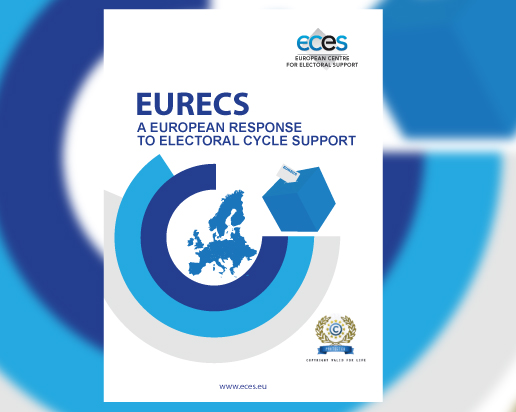
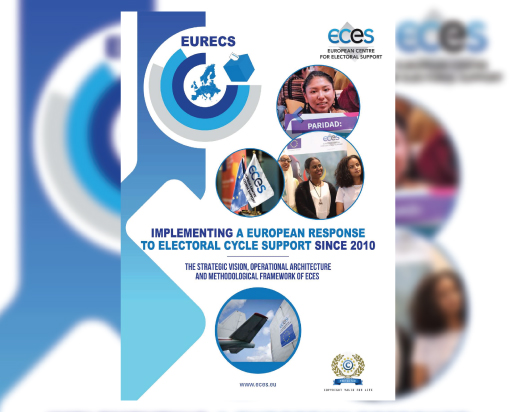
Download EURECS 2016 Download EURECS 2026