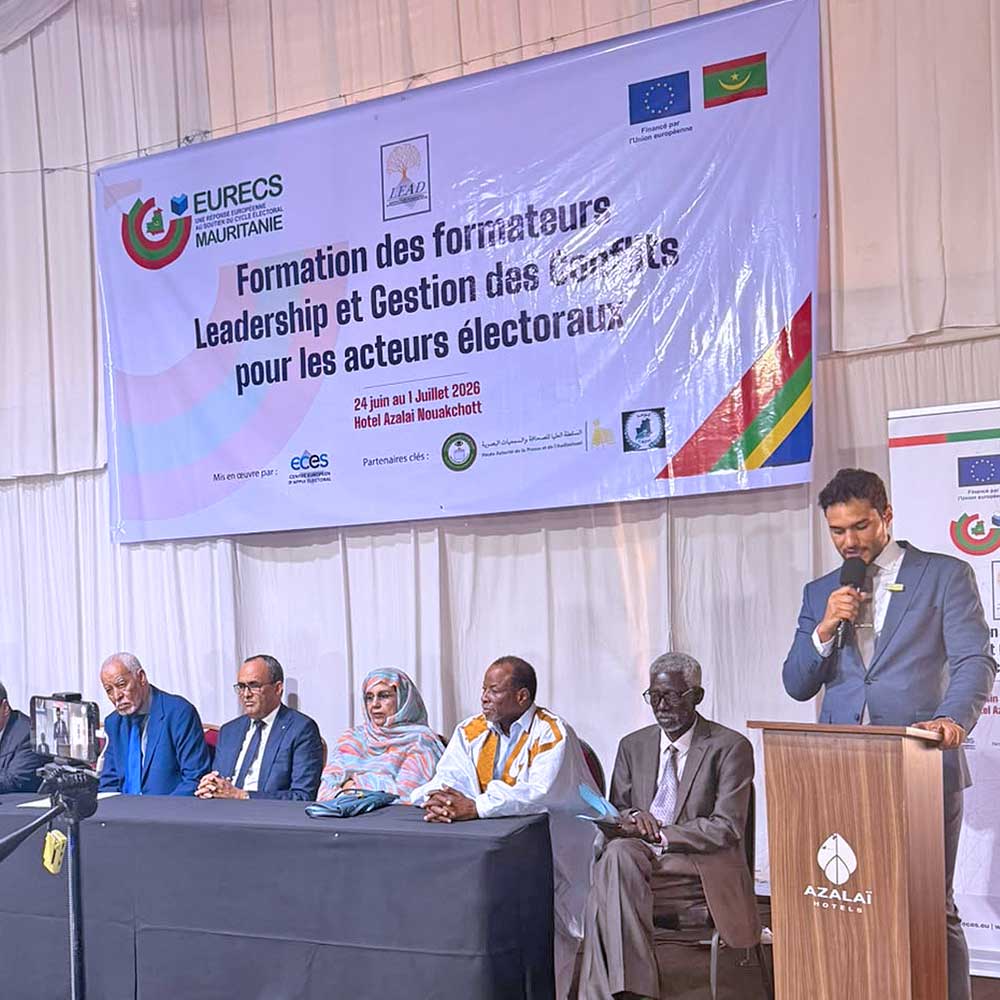
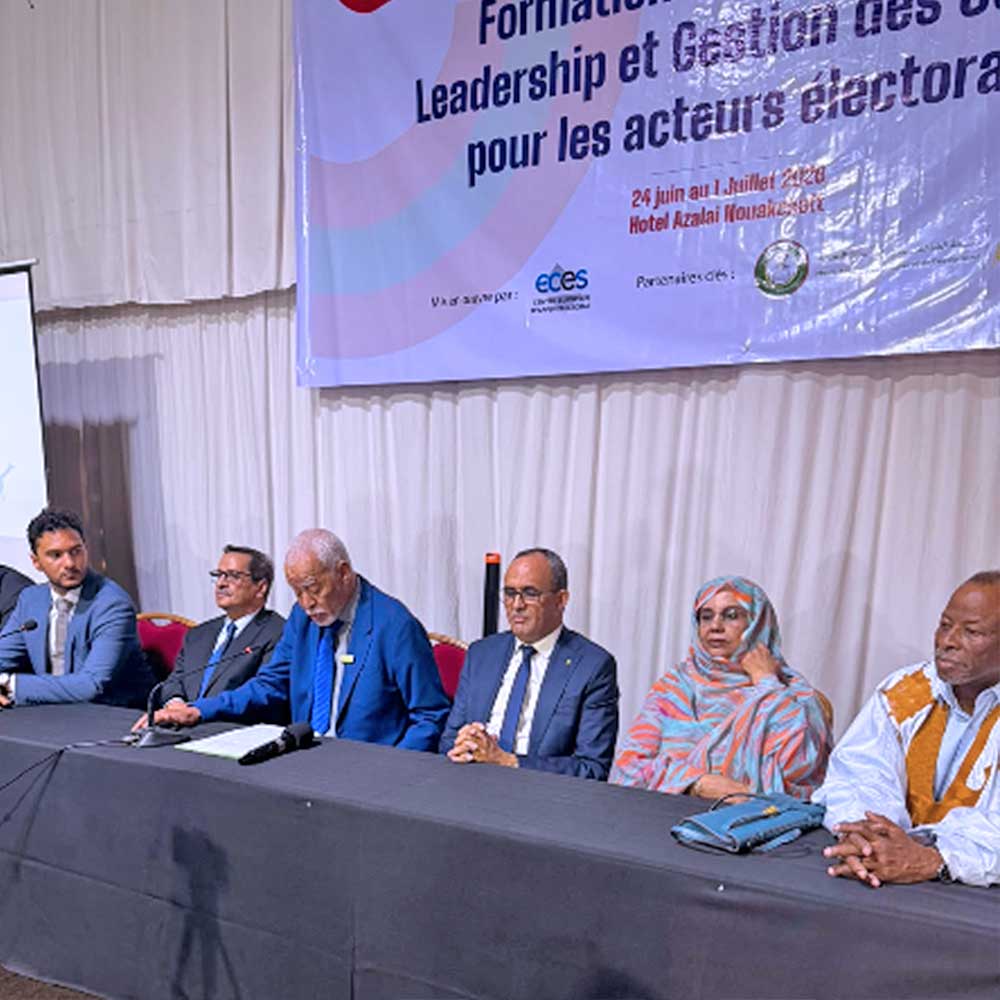
As part of the EURECS Mauritania – A European Response to Support the Electoral Cycle in Mauritania project, implemented by ECES with funding from the European Union, a training-of-trainers course on the LEAD methodology – Leadership and Conflict Management for Electoral Actors took place from 24 June to 1 July 2026. This activity was led by ECES experts Aous Qutaishat, Eva Palmans and Ashref Maktouf, who were deployed to Mauritania as LEAD expert trainers to support capacity-building for partner institutions in the areas of leadership, dialogue and the prevention of electoral conflicts.
The opening ceremony was attended by Mr Abdeljalil Dah, President of the Independent National Electoral Commission (CENI), Mr Mohammed Abd Lahbib, President of the High Authority for the Press and Audiovisual Media (HAPA), and Ms Amna Bent Bamp, Secretary-General of the Constitutional Council. Their presence demonstrated the commitment of the main beneficiary institutions of EURECS Mauritania to strengthening their capacities and promoting constructive institutional dialogue in support of inclusive, credible and peaceful elections.
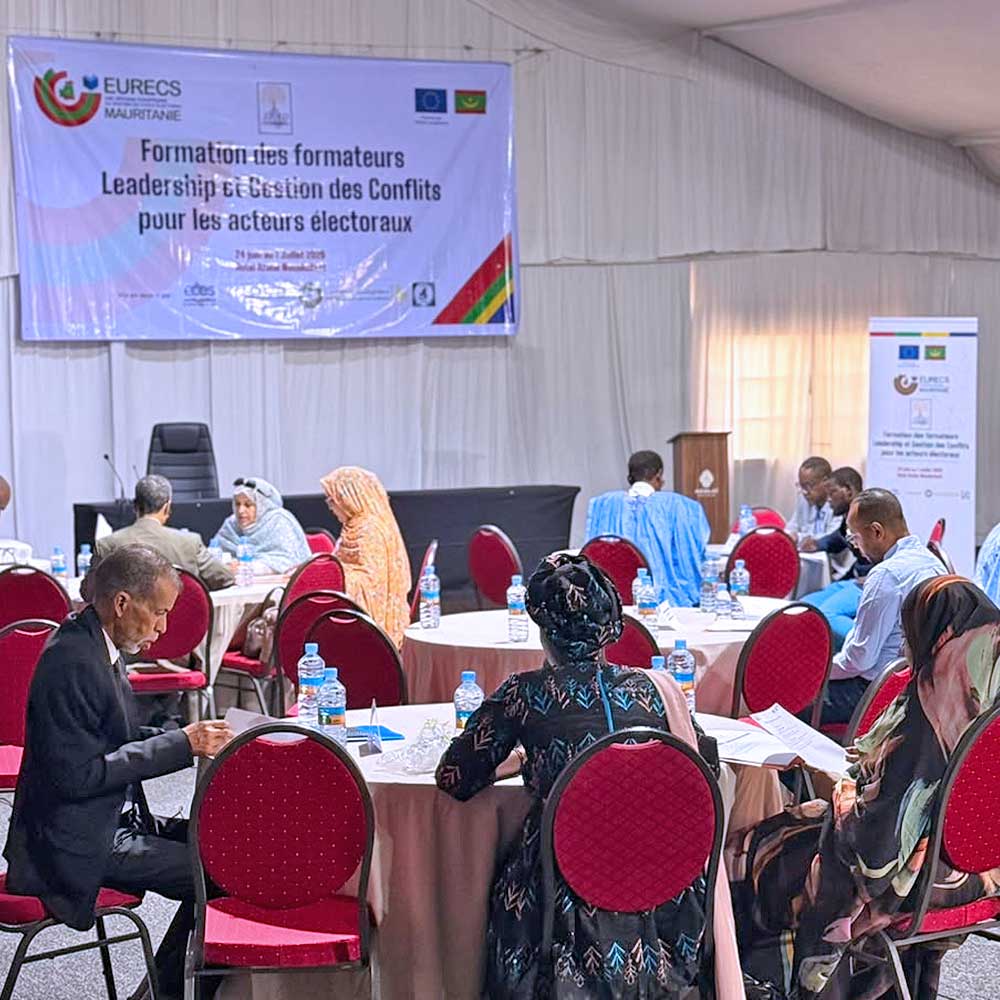
Bringing together 36 representatives from the Independent National Electoral Commission (CENI), the Constitutional Council, the High Authority for the Press and Audiovisual Media (HAPA) and the National Human Rights Commission (CNDH), this training aimed to strengthen the capacities of the main institutions involved in the Mauritanian electoral process in the areas of leadership, dialogue, and the prevention and management of electoral conflicts.
Set against the backdrop of ongoing institutional reforms, national dialogue and preparations for the forthcoming elections in 2028–2029, this initiative recognises the importance of building trust between institutions, political actors, the media and citizens in order to foster an inclusive, credible and peaceful electoral process.
Throughout the seven-day training programme, participants benefited from a highly interactive approach based on the ECES-LEAD methodology, which combines conceptual input, case studies, simulations, role-plays, mediation exercises and group work. This approach helps to develop both the individual and institutional skills required to prevent and manage tensions throughout the electoral cycle.
The programme covered a wide range of topics, including self-aware leadership, emotional intelligence, the analysis of electoral conflicts, stakeholder mapping, strategic communication, mediation, dialogue facilitation, consensus-building, the management of institutional reforms, as well as training skills designed to ensure the knowledge gained is passed on to others. Participants were also introduced to the issues surrounding artificial intelligence as applied to elections and the media, particularly in light of the growing challenges posed by disinformation and manipulated content.
At the heart of the LEAD methodology lies an operational sequence designed to defuse tensions through four complementary stages: listening, showing empathy, addressing concerns in accordance with rules and procedures, and then guiding stakeholders towards institutional and constructive solutions. This approach promotes conflict management based on dialogue, impartiality and the building of trust between institutions and the various stakeholders.
One of the key objectives of this training was also to establish a core group of trainers drawn from the various partner institutions. Thanks to the skills they have acquired, these trainers will be able to organise cascade training within their respective institutions and across the country’s various wilayas, thereby contributing to the sustainable dissemination of the LEAD methodology and the strengthening of institutional capacity at national level.
Through this initiative, EURECS Mauritania is continuing its commitment to strengthening Mauritanian democratic institutions by encouraging inter-institutional cooperation, the development of responsible leadership and the prevention of electoral conflicts, with a view to promoting inclusive, peaceful and credible electoral processes.